
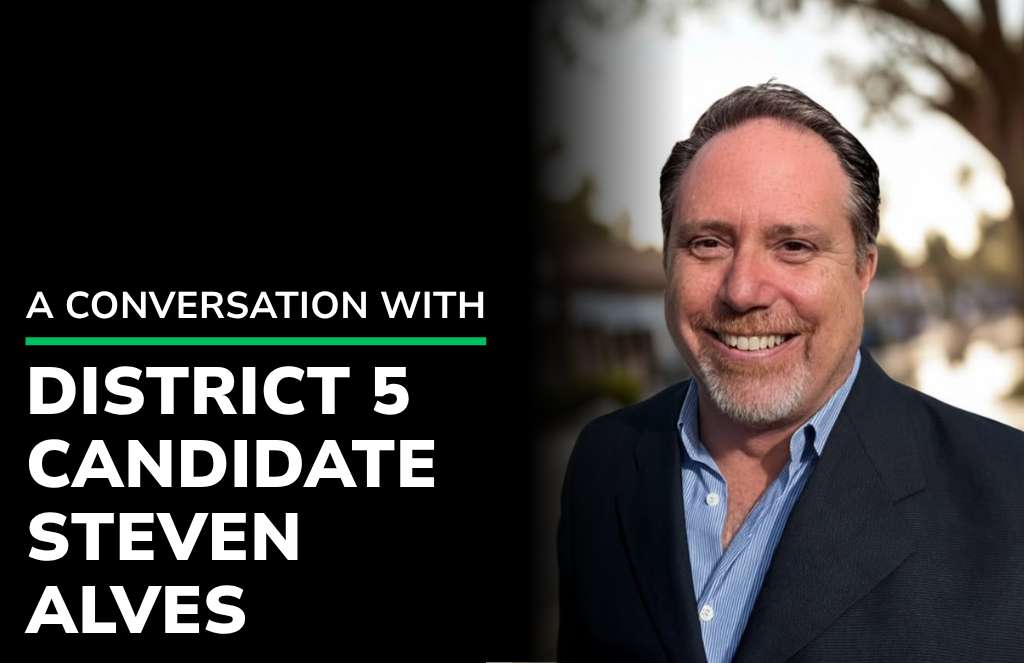
Steven Alves is a Candidate for District 5. This Interview was conducted in mid-September. Questions and Responses have been edited for clarity
Improving the Day-to-Day Lives of Citizens
Christopher Wong: When you’re running for District 5, you’ll go in, and you’ll have an agenda of things/priorities that you want to do. What kind of things do you want to do to improve the day-to-day lives of the citizens in District 5 and, in general, the city of Irvine?
Steven Alves: I’ve lived in Irvine for a long time, but for me, it’s what happens on a daily basis. When I drive down the streets, particularly Alton, and you’re going like a roller coaster ride, it’s remarkable to me that that’s not been taken care of. It’s these types of issues—right through the heart of Woodbridge, right through the heart of District 5. Why aren’t these things being taken care of? These are the types of issues on a daily basis that I want to go down to City Hall and say, “Why has nothing been done about this?”
We need to be focused more on these local issues. Taking into account what the people in my district are going through on a daily basis, my priority is going to be focusing on infrastructure in District 5, particularly as it pertains to the budget and how it pertains to the frequency with which they come through and repave those roads. I know that the city has a schedule, but there are times when we need to take a look at that schedule and say, “We need to accelerate it for here.” There’s a structural problem on Alton that we need to resolve, and we can’t let this continue to get worse because it’s going to become a hazard and a liability for the city.
So it’s focusing on what’s happening on the local level in the district, but also throughout the city. There was a time on Culver, south of the 405 freeway, where it needed to be paved for a long, long time, and the city did nothing about it. Why aren’t we getting this focus back to the local things that affect the residents as they’re driving down the street? That’s one of my key focuses: getting away from divisive national politics and getting back to the local issues that affect the residents.
That’s one of my key focuses: getting away from divisive national politics and getting back to the local issues that affect the residents.
Christopher Wong: The day-to-day operations for the city are truly important for the average citizen because they go to work, come home, grab stuff for their kids, or grab dinner somewhere. What other priorities would you have besides the day-to-day things that would be important for your citizens?
Steven Alves: Certainly, continuing to support public safety and support the police department. That’s the reason that Irvine remains the safest large city in America for 20-plus years running. That’s why I chose to live here, stay here, and raise my family here—because of the safety. I am completely supportive of the IPD and the great work that they do. That affects everybody in the city, particularly everybody in my district and my neighborhood. We feel safe, and that’s really important to me.
Christopher Wong: What about for the city? What other priorities besides IPD are important?
Steven Alves: To support a continued focus on economic growth of the city. We have to start looking at where we’re putting housing in the city, but when we’re done with housing, what are we going to do for economic development? These are things that I thought about and worked on when I was Chief of Staff for Vice Mayor James Mai.
For me, it’s really important to continue to focus on the issues when residents call or write in. It’s that reaction time to what they want and what they need. Sometimes it’s not something you can resolve today, but it’s something you can resolve by putting them in contact with the right person at Public Works and getting the process going—having that close relationship with the residents so they feel heard.
it’s really important to continue to focus on the issues when residents call or write in
During my first or second week working for James, a resident in Woodbridge contacted me about putting up a stop sign—or actually wanting a stoplight—at the south end of South Lake, where the trail comes over the freeway on Yale. I responded, “I don’t know if a stoplight would work there, but let me get you in contact with Public Works.” I put them together, and Public Works went out and did a traffic study. About six months later, they had a flashing stop sign system there. It was a quick resolution to a problem without creating another issue by putting yet another stop sign—as you know, in Woodbridge, there are about a thousand of them. They came up with a flashing pedestrian walk sign that makes it safe for pedestrians. That’s an example of a quick reaction directly to the residents.
Economic Development
Christopher Wong: You touched a little bit on economic development. Economic development is key for Irvine. How would you encourage more economic development within the city?
Steven Alves: Coming from the business world with over 30 years in international marketing and business, doing business in over 50 countries, I’m quite familiar with working directly with companies and negotiating with them.
One of the things I did when working with James was helping convince a Korean multimedia company to move their headquarters from Fullerton to Irvine. We did that in conjunction with the Economic Development Department of the city and the Chamber. My vision for the city is encouraging new companies to come here and bring new streams of revenue by encouraging companies and bringing new residents and employees who will help bolster the city’s coffers. It provides more opportunity for residents with more companies coming here.
My focus would be meeting with companies and working hand-in-hand with the Economic Development Department to bring them to the city, including working with the Irvine Company to find good leases and whatever else incentivizes them to move here. This Korean company now wants to help bring other companies from Korea to move headquarters to Irvine. This can be a domino effect that will help not just Irvine, but the entire region of Orange County.
Housing
Christopher Wong: It’s great that companies will come here, but people coming here for work are going to have to find somewhere to live. Irvine and District 5 are pretty built out. There are opportunities for infill here and there, but it’s going to be difficult. How do we address housing needs for people who want to work and live here in Irvine?
Steven Alves: That’s the question up and down the state, as we have state mandates we have to meet. We have to build anyway because of those mandates, but the focus must be on how we meet the needs of providing affordable housing for employees at whatever compensation level they are hired at.
I know the city is planning to develop more higher-rise apartment buildings with mixed use near the train station. That may be the direction we need to go in areas that can handle urban development like that. At the same time, we have to be sensitive to the needs of people who moved here for a nice, quiet, and safe suburb, and find that balance. I would work hand-in-hand with the Economic Development Department and different builders to find the right solutions.
The city has the right mindset right now regarding development by the train station, but we also have to think about infill going into the IBC and how we can bring amenities to those areas as well. It’s not just about “stacking them and packing them” in high-rise apartments where nobody has a life outside their apartment or contained pool walls. How can we find green space for them in those new development areas? Those are important matters to consider while still making it attractive for employees hired by the companies we are enticing to the city.
Services and Expenditures
Christopher Wong: Parks are a service, and IPD is a service for public safety as well. How do we tackle supplying these services and meeting needs like city events—for example, the Global Village Festival—while dealing with a constrained budget and staying flush?
Steven Alves: You may recall we used to have the Harvest Festival here. I miss those days of the Harvest Festival; those were fantastic. We have the Global Village Festival now, and I see that as a tie between economic development and providing fun events. We should go to the new companies coming here and get them to sponsor certain parts or percentages of these events. The more sponsors we find, the more we can cover the costs of these fun community events.
Global Village is completely packed every year and very popular, so I wouldn’t want to see that go away under budget constraints. We need to find a better way to reach out to corporate entities in the city to see if they’re willing to take on some of that financial burden as the city looks for creative ways to bring on these events.
For me, it’s a matter of making sure every dollar we spend goes as far as possible and reaches the most residents possible. Focusing only on a small percentage of the population is not the best use of taxpayer dollars. We need to keep the budget tight and spending down while continuing services. As the population grows, we have to expand services to meet that growth, watching that budget and redirecting dollars to ensure core services—from public safety and IPD to public works and maintenance—are covered.
As the population grows, we have to expand services to meet that growth, watching that budget and redirecting dollars to ensure core services—from public safety and IPD to public works and maintenance—are covered.
We also want to ensure older areas like District 5 don’t miss out on maintenance taxpayer dollars or get overlooked like we’re currently being overlooked on Alton. We want taxpayer dollars spent in older areas of the city that might not be as shiny and new anymore—we’re still here, we’re residents, and we still have a voice.
The Library
Christopher Wong: As our budget is constrained, we have to deal with the library system. We pay a non-insignificant amount of rent to the county every month for libraries. Do you have an idea of how you would tackle this library issue?
Steven Alves: I know how fantastic the libraries are. My daughter has been going to the Heritage Park Library recently and says it’s so crowded it’s hard to find a seat. On one hand, that’s exciting to hear; on the other, it makes me think about how we ensure those services are provided down the line.
We will be getting property taxes that will be used toward funding our current libraries. Our district is particularly concerned that the lease on the University Park Library will be up in mid-2029. We want to ensure we have solid negotiations with the county to continue leasing that property. Currently, the county is refusing to sell us that land, so that’s not an option right now. We need to continue looking at options for lease negotiations.
It’s about a 10,000-square-foot facility, so we’re looking at roughly $4 a square foot. In the grand scheme of rental rates in Irvine, that’s not bad, but looking at a bottom line of $40,000 a month, that’s eye-opening. We want to ensure we continue to fund the library system and maintain current staffing levels now that it falls within the city’s realm. We took on that burden, and it’s not going back, so we have to find a way to keep it going.
Christopher Wong: Why Steve?
Steven Alves: I really care about the city and my district in particular. I moved here in 1990 into an apartment a couple of years after college. We drove through Woodbridge, and I fell in love—I had never seen such a beautiful place. I’ve been here ever since.
I bring a love of the city, an understanding of my neighborhood and district, and a history of contributing to the community through over 14 years of volunteering in scouting as an Eagle Scout coach and teaching Citizenship in the Community. I feel it’s my duty to continue that.
I also bring 30-plus years of business experience, running my own business since 2004, traveling the world, and conducting negotiations in over 50 countries. I bring diplomacy, an ability to sit down and come to solutions with anybody, a calm demeanor, a business mindset, and a commitment to put pencil to paper to keep the budget on track. I want to focus solely on local issues—nothing from national divisive politics—and bring all my experience, combined with my year and a half working at City Hall. That sets me apart as a unique candidate.