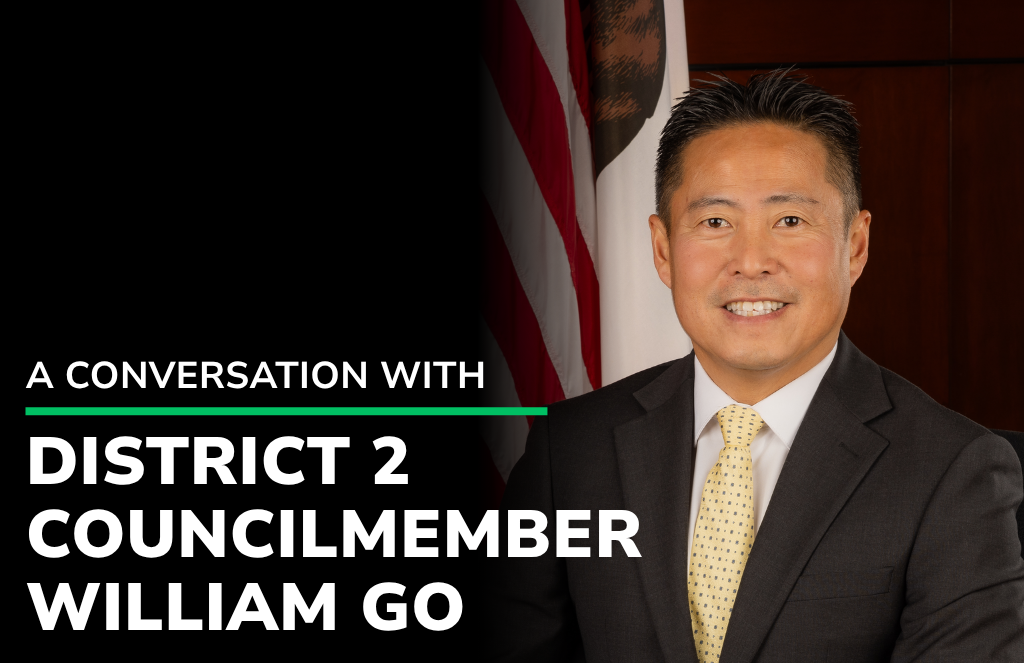
William Go is the Councilmember representing District 2. This Interview was conducted in late August before the Daisy Chain Festival. Questions and Responses have been edited for clarity
Introduction & District 2 Overview
Christopher Wong
You represent District 2, which covers the Great Park, but you have these outlying areas. How do you make sure that those outlying areas are also served in your community?
Parks, Funding, and CFDs (Community Facilities Districts)
William Go

The nice part with District 2 is we have good developers. The Irvine Company master plan includes Woodbury, Cypress Village, and Portola Springs. With that, we received a lot of good benefits like public parks. With the Great Park Neighborhoods, it was master planned through FivePoint. They did a pretty decent job in terms of neighborhood parks, but those are more HOA parks. A lot of people don’t quite realize the difference between an HOA park, a city neighborhood park, versus the Great Park. It’s kind of like apples and oranges.
The HOA parks are funded through their HOA dues. Neighborhood parks are funded through city tax dollars. The Great Park is funded through Mello-Roos CFDs.
The part that gets a little bit nuanced is that Portola Springs, Woodbury, and Cypress don’t pay the CFDs, but Great Park does. It’s different than a community park that comes out of general tax dollars. It’s just different buckets, so they can’t always be treated the same because of the way they are funded.
The struggle is how you balance it when you only have this part of the neighborhood paying for the Great Park versus how that benefit flows through. One of the biggest challenges: the people who do pay the CFDs always ask, “Hey, we’re fine paying for it because we signed up for it, and we’re not going to complain about that. But because we’re paying for it, we should have either more of a voice—whether that’s possible or not, we’re trying—or special benefits as founders or taxpayers, offered above and beyond what normal citizens get because our taxes pay for the Great Park.”
If we can work through those challenges, we can create a win-win situation for everyone.
Obviously, District 2 is a great area because it’s new, and we have the latest and the greatest in terms of schools and parks. Those are the advantages. But we can’t forget that there are multiple sources of funds. The part people get confused with is thinking it’s all in one bucket. Even when I suggest other projects, people ask why we are opening a public aquatics facility or a sports field when there are already HOA pools and facilities.
Because those HOA pools aren’t open to the public. That’s what we need to look at and make sure there’s enough equity to go around for everybody. Even for people who don’t live in the Great Park neighborhoods.
Great Park Destinations and Revenue Streams
Christopher Wong
This is a good segue into the second question about Great Park. We’re trying to make this a destination for people to visit. For example, at the time of this interview, this weekend will be the Daisy Chain Festival, which is huge. CFD dollars are spent on the Great Park to make it a destination, but city dollars should also flow into that as well because the city benefits, right?
William Go
That’s the struggle, because the CFDs bear the brunt of the infrastructure costs—rightfully so, that’s why it’s there. But when you produce income from that infrastructure, that’s where it gets muddy, because that money becomes part of the General Fund. It stays operationally in the Great Park, but it can be moved freely. Let me clarify a little bit: the roads and basic infrastructure—the actual construction comes from the CFDs. Ongoing maintenance is funded by the city budget. The developer built those roads, and when they are turned over to the city, they become city property, making maintenance a General Fund item.
Transit, Irvine Train Station, and E-Mobility
Christopher Wong
There is a great project happening right now that will connect the Great Park via an underpass before the Irvine Train Station. The Irvine train station has been a central topic of development—not only that underpass, but housing in the area. What other projects are you pushing for in that area?
William Go
It’s really important right now to get that underpass done because it connects the park to the train station. One of the challenges with Daisy Chain is that we’re encouraging people to take Metrolink or Amtrak, but there isn’t an easy way to get from the station into the park due to road infrastructure. That’s being worked on, and hopefully by next year, it’s done. That’s a big benefit for everybody.
As far as reactivating the train station, it’s important to have transit-oriented development projects there. The site is going to be a future high-density downtown area, hopefully with lower parking requirements, encouraging public transportation as a primary use. We also have the Bike Mobility Center project at the train station to support alternative transportation.
While we encourage alternative transit, we have to support it. With current economic conditions, Bike shops are starting to find it difficult to survive, so the city has to step in and make sure resources are available for people commuting via mobility devices.
Christopher Wong
I don’t think people realize there is a city-owned facility in that train station. What is the city looking to do with those spaces?
William Go
The city owns the real estate in the train station—the waiting area as well as the parking structure. It was funded through a federal grant that OCTA facilitated and built, but the city retains ownership and maintenance. Within that structure, we have downstairs retail spaces. We’re trying to populate those for community-based services. With mobility hubs, we’d love to get a cafe in there—anything to bring life back so it’s easier and better serviced for commuters.
Christopher Wong
We have different popular hubs around Irvine. What kind of impact do you want to see the Irvine Train Station play within the overall hub environment of Irvine?
William Go
A mobile-centric feel and environment is definitely welcome there. We have a parking structure that fits a few thousand cars, but we’d like to see more people using e-bikes, e-scooters, and regular bikes. Anything that gets people out of cars and fits more commuters on the road will relieve congestion. Services like that are a primary focus, and we’re moving forward with projects to make mobility sustainable there.
Budget Constraints and Great Park Development
Christopher Wong
I had a discussion with other council members about the Irvine city budget—things we want to do versus what we have to scale back due to realistic budget constraints. How will that affect Great Park development? Will that have an impact on some of the grander projects you might want to do?
William Go
Overall, it will have an impact, but fortunately, because the capital projects are funded through the CFDs, it shouldn’t severely hinder development. At the end of the day, it’s a balance with operational costs and inflation. The nice part is we have the CFDs bonded to ensure these core infrastructure projects move forward. However, inflation and labor costs have gone up, so our money doesn’t buy as much as it did 10 years ago. That’s a drawback that impacts the overall budget with similar constraints.
Economic Development and Commercial Spaces
Christopher Wong
The Canopy is coming to the Great Park, bringing new shops and one of the best supermarkets in Canada to Irvine, which everyone is looking forward to. These spur economic development. What else are you working towards for economic development in your district as well as the city?
William Go
There is a lot more of the Great Park that needs to be developed. For example, the two giant hangars in the back at the Cultural Terrace—we should look for options there that generate revenue for the city, along with event spaces like Building 369 to create more commerce through conventions, events, and collaboration. In conjunction with the Innovation Center we’re establishing, it goes hand in hand with Great Park projects. Moving forward, my focus is balancing the park to make sure infrastructure costs are put into uses that generate income, rather than always costing taxpayers in annual operational expenses. It’s fine to provide public benefits, but it can’t be so lopsided that you have no income offsetting those operational costs.
My focus is balancing the park to make sure infrastructure costs are put into uses that generate income, rather than always costing taxpayers in annual operational expenses.
Orange County Fire Authority (OCFA) Services
Christopher Wong
It’s been a really hot summer. Let’s talk about the Fire Authority. Has OCFA met your expectations? Do you think they are doing well, or could they do more to help your constituents?
William Go
OCFA is a great organization. They are well equipped and do a good job protecting us regarding safety and fires. But like any Joint Powers Authority (JPA), Irvine is one of the biggest cities paying into the system.
We want to make sure we have an advocate on the OCFA board who understands how to balance these resources and fight for our fair share. It’s not a perfect science where every dollar comes back, as resources are shared among all member cities during large emergencies. Performance-wise, OCFA has done a great job, and everyone loves the firefighters. But as a city, we have to wear two hats to ensure our local interests are looked after.
Community Facilities: Libraries and Community Centers
Christopher Wong
Let’s talk about the library system. Councilmember Betty Martinez-Franco is fighting for the University Library in District 5, and Councilmember Melinda Liu is dealing with Katie Wheeler—both are county-owned library plots, even though the city owns the buildings. But a huge number of Great Park constituents don’t have a local library and have to go all the way to Heritage. Given the city budget, are we still looking to build a library in the Great Park?
William Go
We are looking at funding sources to build a library within the Great Park, which falls under CFD eligibility.
However, those CFD funds have already been allocated for various other parts of the Great Park. Friends of the Library created a foundation for fundraising, and we are exploring new projects to potentially generate development revenue to pay for constructing a Great Park library.
Christopher Wong
I realized you don’t really have a public community center at the Great Park either, right? The community centers there are HOA-maintained.
William Go
Right. Anything on HOA land or real estate allocation is private—you have to belong to the HOA or be a resident. For public facilities, the Great Park has the visitor center and artist studios, but those are programmed spaces rather than general community centers. There definitely needs to be a planned public community center. The park has great open space, fields, grass, and playgrounds, but it lacks the standard public community center facility seen in Las Lomas, Cypress, or Woodbury.
Upcoming Great Park Projects and Future District Goals
Christopher Wong
Is there a particular project happening in the Great Park that you’re really excited to see occur within the next couple of years?
William Go
The most exciting part is that the heart of the park—the lakes—is finally coming together. We’ve already bid out hundreds of millions of dollars in contracts to get that started. While the sports fields have been utilized for a while, they don’t necessarily serve casual neighborhood use. The central park area caters to passive neighborhood use—strolling, walking, and enjoying the lakes.
Beyond that, the Flying Leathernecks Aviation Museum is targeted to open around 2028. Even though it’s run by a non-profit, it benefits the general public broadly. The park elements coming online now offer more universal public use.
Christopher Wong
Are there any other goals you want to see accomplished during the remainder of your term?
William Go
We want to keep moving the park ahead as fast as possible.
Christopher Wong
What about the overall district?
William Go
District-wise, as District 2 approaches full buildout, we want to make sure everything is balanced. The school district is doing some rebalancing—we had issues with Woodbury parents being shifted—so we need to stay in lockstep with IUSD 10 to 30 years out so families aren’t surprised by last-minute changes. School quality is a primary reason people move to Irvine.
Regarding retail: as more homes fill up, we need neighborhood-serving commercial options. Near the train station and bordering the Irvine Spectrum, older industrial and office space will eventually be repurposed into residential mixed-use developments. As Irvine matures, transit-oriented mixed-use options will give the next generation affordable housing options to stay in Irvine.