
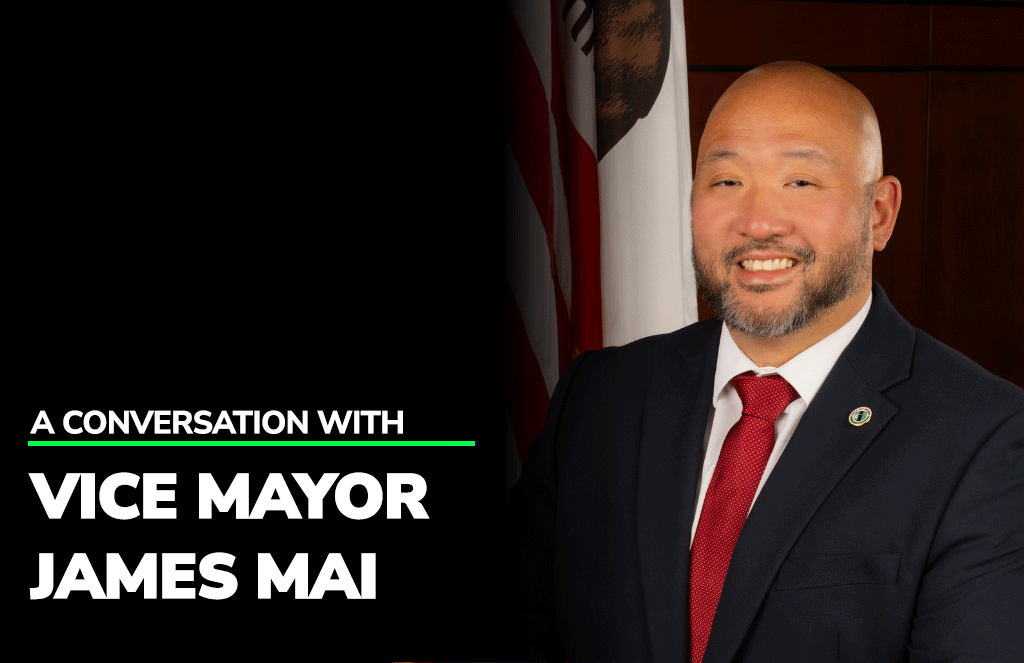
James Mai is the current councilmember for District 3 and the Vice Mayor of Irvine.
Utilities
Christopher Wong: Irvine residents are facing higher utility costs. What tools does the city actually have to help residents manage those costs? And are there additional things you think Irvine should be doing?
James Mai: Well, affordability is a major cost in the city here, especially for seniors. Especially in my district, there are a lot of seniors. Rising costs of groceries, rising costs of utilities- everything is impacting them because they are on fixed income. That’s a major issue.
We do have the tools to help. One of the things I did early on was that we were able to give a grant out for people living in older homes. We were able to provide loan options at 0% interest that are non-repayable until you actually transition the home or trade the title; or, if the person passes away, it becomes repayable from the equity. So, there are things like that which I’ve championed and that we can do as a city. That loan program is still active.
It was very popular. In the first round, people signed up, and we exhausted the funds. Again, I pushed for another round. We got another round. And it’s just something that can help people with their utilities. That loan can go to paying for a new electric dryer or something that helps them save on the water bills, some on electricity bills as well. So, we’re able to do things like that.
Another thing is Orange County Power Authority, giving the choices to residents. We’ve also tried giving choices on things like broadband as well. Broadband traditionally has been managed by one or two companies. In some of the older areas of Irvine, it’s just one company. You’re stuck with that.
I wanted people to have a choice. So, we’ve brought in another broadband provider (Cityside Fiber), and now people have the choice of paying a lower cable bill. I mean, it helps. Every single cent helps. So, I think that things like that where we can find and help people with finding solutions and giving them greater choices of utility providers is a good thing.
Needs and Services
Christopher Wong: District 3 is very diverse in terms of neighborhoods. It’s very built out, the age, and the needs. How do you determine whether city spending and services are distributed equitably across the district versus the city?
James Mai: You know, the thing about equity in districts in Irvine, I don’t think equal means identical. It’s different needs in different areas. Some areas, like ours, which is older, have different needs than something like the Great Park or the Spectrum. It’s a different need. So, the spending is not going to be the same. It’s always going to be different.
So, I just have to make sure that we’re not overlooked for our residents and the needs of the district. I won’t compare how many resources or how much money is spent in mine because it’s all subjective to the actual needs.
My number one priority isn’t to say, “Hey, we’re not getting our fair share.” My number one priority is, what does the community need? So, that’s how I look at it.
My number one priority is, what does the community need?
Christopher Wong: Irvine has a lot of projects and competing demands for taxpayer dollars. How do you distinguish what the city needs to provide and what residents may simply want the city to provide?
James Mai: There are a lot of people that want different things, and I think collectively, people need to understand that we can only do so much.
I always look at it the same with my kids. When I talk to my kids, they say, “Dad, I want this. I want that.” I say, “Well, do you need it? Is it going to prevent you from moving forward? Is it going to make your life any worse if you don’t have it?”
So, we prioritize things that way. What do we need in the immediate future and in the long-term? If we want some extra gravy, we’ll go for that extra gravy, but let’s get down to nuts-and-bolts basics and give the basic necessities that everyone needs and that are lacking, complete those projects, and then go on to the next thing.
Christopher Wong: But that doesn’t preclude Irvine from looking at things and going, “Hey, maybe we could plan for this,” or “Hey, what’s the feasibility of this project?”
James Mai: Absolutely. We should always look to what could potentially be on the horizon and maintain a wish list. The city and our staff do a great job with long-term planning and keeping a priority list of upcoming projects—as well as those further down the road. I really appreciate that they keep us updated with that long-term list.
Christopher Wong: For those long-term projects, are you always looking for external sources of funding for those projects as well?
James Mai: Usually. That’s the priority. We’re always going to look for external funding. And my own philosophy is, I believe there’s a lot of funding through the county that we can tap into, and I always defer to that first.
Christopher Wong: Can I ask for a more specific example? For the JOST bridge, I understand that our representative Dave Min helped bring in some of that money. But was that a project that was initially planned first, and then we said, “Hey, Dave Min, can you find us money for this project?”
James Mai: Dave was one funding source, and then the other partner was Lan Tran. She was there representing our other partners and funding sources. I don’t know the exact details on how it was mapped out since it was before my time, but I believe they worked directly with county funding sources beforehand.
And I’ll give you an example—not just of the JOST, but, for example, the food insecurity program that we wanted. A lot of the residents wanted it, and some of them needed it. I said, ‘Let’s tap into the non-profits in the area that are funded by the county and have programs available that cities can actually tap into.’ And it won’t cost the city anything to bring a food distribution program here.
Second Harvest helps out, and same with the OC Food Bank at the Community Action Partnership of Orange County. Those are two of our partners, and they provide everything—they even provide the logistics. They bring it to us: a diaper program, a food program for seniors, and one for everyone. It’s things like this that I think cities can look into, but no one has really done in the past. That’s where we need to be—if we have any sort of wish list, we should see what’s available out there.
Economic Development
Christopher Wong: What can Irvine realistically do to encourage economic development and attract businesses, jobs, and investment, particularly as the city faces increasing costs and pressures on its budget?
James Mai: Yeah. So, economic development is a big thing for me. You know, we have the Center of Innovation and Economic Development doing things like that. But outside of that, I think it’s the ground game that we need to step up with. I mean, I’m not saying what we’re doing isn’t sufficient enough, but something I want to continue to do is take care of the businesses that are currently in Irvine so they don’t leave. They don’t move to Tennessee, they don’t move to Arizona, they don’t move wherever.
Making sure that they feel the love from the city, that’s number one. Taking care of them, making sure that, you know, we have a touch, they have a representative of the city, that, “Hey, we’re encouraging, we’re supporting their growth as well.”
Also, I believe in recruiting businesses to Irvine. We’ve been able, working with the chamber, to recruit more than five businesses to the city of Irvine. One of them—ODK Media—is basically the ‘Netflix of Korea.’ They’re a massive platform.
They were based in Fullerton, and their lease was up. And they’re like, “We don’t know where we want to go.” Someone told us to talk to Irvine to see what you guys can provide us. I met with their executives and they came here. One guy flew from Korea here to meet with me right in this room here and we talked about the benefits of having Irvine, the talent pool that we have here, and really telling them the benefits of coming to Irvine.
So, I think one of the biggest things that we can do is recruit more businesses to the city of Irvine to bring more tax revenues and bring in more jobs to the city. In a couple hours, the city is going to a grand opening of a large project management company that’s going to be based at the Spectrum. So, we get excited about this. So, it’s something that we do to help them and make it easier and help them know that there’s a talent pool with the schools that we have here.
I want to make it the most, the most, attractive place for people to come to live. And then you, as the businesses, have your talent pool. That’s how we’re going to that’s how we’re going to build this city up at this point, because we’re built out on the residential side. Over the next 10 to 20 years, Irvine’s next phase will focus on supporting local businesses and expanding economically to become a powerhouse in Orange County.
I want to make it the most, the most, attractive place for people to come to live.
Housing
Christopher Wong: You mentioned that Irvine is largely built out, but are we going to explore workforce housing options for local businesses? I know remote work isn’t always viable—sometimes having an in-person team is necessary, and shorter commutes make a big difference. Does the city have plans to help address workforce housing to support our local companies?
James Mai: There absolutely is right now, and it’s been implemented. If you look at the Marketplace right now, where some of the newer buildings and apartments are designed for people that are entry-level workers or smaller families, or a younger generation. We want to make sure it’s affordable for them. So, we’re working with the builders in terms of their designs, even, and saying, “Hey, you guys don’t need to build out these giant single-family homes that cost $1 to $2 million.” Because most people working entry-level aren’t going to be able to afford that.
But what they did was, for example, at the Marketplace, it’s designed to be entry-level. It’s a little bit more affordable than, you know, a big three-bedroom apartment that you’re used to in Irvine. It works because a lot of these people are younger, and they don’t need a fireplace; they don’t need a giant living room. They just need a place to sleep, work, eat. Then they do all their amenities out in the retail area. The parks are downstairs. They walk their dogs; they go to the gym outside.
Some of them don’t really cook. Just go eat downstairs somewhere. So, it’s a different lifestyle change, and we have to, as a city, we need to take that into consideration because there are different needs. That’s the great thing about Irvine: there are different needs. You want to be an established executive moving here, you have a family of three kids, you’re going to look for a single-family somewhere in an older area. You’re 20-something, just graduating college, getting your first job. We have it all.
Projects – Current and the Future
Christopher Wong: Looking at your time on the council, what accomplishment are you most proud of and had maybe the most tangible impact on District 3 so far?
James Mai: Well, I think one of the most controversial ones was OCPA, because everyone was on the highest tier when they came in. But I found a balance that, “Hey, we’re still going to have people move them to the lower tier; they’re still contributing.”
I always say that government should never be in the business of mandating morality. If you want to contribute to climate, then you can. You can pay for it. But give people the choice of that. So, you know, I think I’m pretty proud of that because I was able to give people the option of that without having to alienate everyone. The freedom of choice is big.
Same with broadband. I worked with CitySide Fiber to get them here. They invested $50 million in that. That was a big one. I’ve been waiting 25 years to have upgraded fiber internet in my neighborhood. I got into office, made the push and they made that investment.
One of the things I wanted to accomplish was bringing in a PACE (Program of All-Inclusive Care for the Elderly) center for seniors, as we have over 60,000 seniors that are eligible in the area. And nobody in South County has this. It’s only in Garden Grove and above. I wanted to bring a center here. A PACE Center is opening up here, CalOptima has purchased a building already.
Again, we don’t have to pay for it. That’s the greatest part. CalOptima will pay for it. That’s our partner. They’re going to put it here because it makes sense for them. They’re going to get their reimbursement rates.
And then also, just I’m generally proud of being able to deliver things for the community and for people of all walks of life. I prioritize people, and doing things that people can feel, just like the food program that we have. Pushing forward for that food program and making sure that people are aware of that was a great need as well.
Christopher Wong: What are the biggest things that you still want to accomplish on the council?
James Mai: So, you know, a lot of things are not complete yet. I mean, we have a list of projects that are going on that we still need to implement. We’re working with our partners. I mentioned CalOptima, but then the Melinda Hoag Foundation is another one that is looking to implement right now as well, a non-profit center somewhere in the city. I mean, we need to do things like that, complete these projects that we started over a year ago.
I think the challenge isn’t about getting things ready or wanting. It’s just implementation. So, I think there are a lot of things that need to be implemented before we dump more onto the plate, and I’d like to see that executed.
The Budget
Christopher Wong: We talked about the budget and about the structural deficit that was covered this year by pulling from reserves. How are you looking to tackle that kind of budget problem?
James Mai: Well, one of the things that I’m most proud about this past year is sounding the alarm on the long-term budget issue. It’s not really an easy conversation to have in Irvine. Irvine is award-winning for being fiscally strong. But being fiscally strong today doesn’t mean that you should ignore what’s going to go on tomorrow.
I started asking questions about the structural position, our use of reserves as you mentioned, growing expenditures, and where the city is going to go within the next 5 to 10 years. Surprisingly, the number of the deficit was actually shorter than that. So, we’re facing a deficit this year, we’re facing deficits next year, and a potential deficit in a couple years.
That’s not what fiscal oversight is supposed to be. You don’t wait until there is a crisis to start talking about the problem. I think a lot of families are being squeezed right now. Costs are higher and one of the things that was really concerning to me is facing a deficit
We can dip into reserves, but some people were saying, “Well, we’re facing a deficit. Why don’t we just raise taxes? Why don’t we raise fees?” I don’t think that the initial thought process should be, “Hey, let’s tax people on four different types of taxes.”
We have to take a look at expenditures, our long-term expeditures, at our overhead and why we are in this situation and where. The answer shouldn’t be, “Hey, if we’re facing a deficit, let’s start cutting everything.”
The answer is to have some long-term planning, and some planning for raising revenue as well. It was just concerning that we had four different types of taxes potentially being spoken about with city management and certain members of the council without anyone else knowing. That is a concern to me. The next conversation that we had was, “Let’s just raise fees on everyone.”
I don’t agree with that either. That’s not a long-term plan. I think I mentioned it on the dais as well, raising credit card fees and raising usage fees, that’s just a part of the solution, but you’re facing a potential $40 million deficit. Raising some credit card fees on people is not the solution. It may be part of the solution, but it’s not the answer to say, “Hey, let’s just find where we can just ding people.” We should start looking at long-term solutions, and part of that long-term solution is economic development. That’s why economic development is very important to me: to bring in commercial tax revenue to the city. That’s why I’m talking to companies and trying to bring them over here.
Just recently we were talking to a group of foreign investors this week even, and there was a group of 50 people who were interested in purchasing businesses in Irvine, or relocating their businesses in Irvine. In September, I’m going to be talking to a group of 1,000 investors that are coming to Costa Mesa, but many of them have said, “We want to have our families in Irvine.” It’s my job to talk about how great the city is, and I believe it’s all of our jobs here at city council to build the greatest city in America so that people want to relocate their businesses here, have their families live and work here. So long term, we need to focus on economic development.
I believe it’s all of our jobs here at city council to build the greatest city in America so that people want to relocate their businesses here, have their families live and work here.
Christopher Wong: So I’m gonna follow up on that trend about economic development. We can economically develop and bring in a tremendous amount of revenue into the city, right? But we’ll still have a spending problem if we keep spending.
James Mai: 100%. That’s why I mentioned economic development and commercial tax bases as long-term. Short-term, we need to take a look at the books. We need to see where the expenditures are going, where we’re hemorrhaging. That was the first thing I said, the first thing you should do when you’re in a deficit is find out what’s your top expense items. I don’t think the city has done that in the past, and that’s why I called for a forensic audit, but that was shot down by the majority.
I was kind of concerned about that already, because why wouldn’t you want to know where the expenses are? Why wouldn’t you want a deep dive on it? Even at the staff level, we can do that. We don’t have to call in outside people to do a forensic audit; we can do our own auditing as well. But when I raised the question, “What are the top 10 expenditures in the city?” I didn’t get an answer. The answer I got was, “Let’s raise taxes.”
That’s not how we should operate. We’re waiting to see with the new city manager, he’s going to take a look at it. He’s very experienced. I’m very confident in his ability to answer the tough questions. I gave them a laundry list of items that I read—it took me about 10 minutes to read—and it bullet points on what I want. So we’re going to get the answers. We’re going to get the answers, and we’re going to find a solution. We’re going to build short and long-term solutions.